
In a video game landscape increasingly dominated by digital storefronts, Sega President Shuji Utsumi caused a stir by reaffirming the company’s commitment to physical media. “Originally we were a platform provider and, of course, we still value the culture of physical media,” Utsumi noted, emphasizing that Sega has no plans to abandon physical games even as digital expansion remains vital.
However, this stance collides with an imminent wall. As traditional platform holders move toward purely digital ecosystems and disc-less consoles, independent publishers will lose control over how their physical games are distributed.
If Sega truly wants to lead the defense of physical media and preserve game ownership, it cannot depend on Sony or Microsoft. It would have to build its own sanctuary.
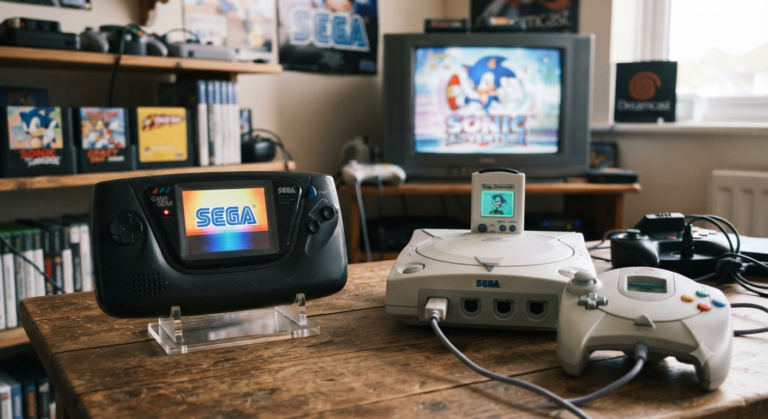
Here is how an updated concept for a hypothetical Sega hardware family could launch, combining the nostalgia of its most legendary brands with an ecosystem centered on physical media without repeating the financial mistakes of 1999.
“Nostalgia for physical media is great, but when platform owners close the disc factory, publishers are left with only two choices: adapt or build their own door.”
1. The Tech Partner: Intel Enters the Console Arena
Launching a console with custom hardware is astronomically expensive, and Sega cannot afford multi-million dollar hardware losses on its own.
The solution? A strategic hardware partnership with Intel.
Intel has been aggressively expanding its footprint in mobile architecture and efficient x86 chip design, leaning on cutting-edge innovations like the advanced Core Ultra family (built on the 18A process node). Partnering with Sega gives Intel a mainstream consumer platform to showcase its mobile Arc graphics architecture, XeSS AI-driven upscaling, and frame generation technologies directly against AMD’s dominance in consoles:
- Subsidized R&D: Intel co-funds hardware development and supplies custom processors at cost to position its Arc architecture.
- Brand Strategy: Sega gains enterprise-scale chip manufacturing capacity, while Intel secures a high-profile platform to test its graphics silicon against AMD.
- AI-Driven Processing: Intel’s XeSS upscaling allows low-power chips to render native-quality graphics on 4K displays without excessive power consumption.
2. Goodbye Optical Discs: The Era of the “Mega-Cartridge” and microSD Express Storage
The traditional optical disc is dying. Discs require bulky drives, higher manufacturing costs, and lengthy installation times that kill the true “plug-and-play” experience.
Sega’s new ecosystem completely dispenses with laser drives by betting on a robust physical format and a modern digital storage system:
- Sega “Mega-Cartridges” (NAND Flash): High-density physical cartridges based on high-speed NAND Flash memory (similar to next-generation cartridge technology). They contain the complete game locally, with no mandatory internet downloads and a read-only design built for physical collecting and instant loading.
- Internal Storage via microSD Express: Instead of mechanical hard drives or bulky internal SSDs that hike up system costs and generate heat, the Dreamcast 2 and Game Gear 2 feature a direct slot for microSD Express cards. This slot functions as the console’s primary internal hard drive, enabling users to download and install digital games, patches, and DLCs from the store quickly and modularly at PCIe speeds.
- Key Cards for AAA Partners: For third-party publishers that do not wish to manufacture NAND Flash cartridges, Sega offers a physical card format featuring a commercial activation key, keeping its own first-party titles 100% on physical cartridges.
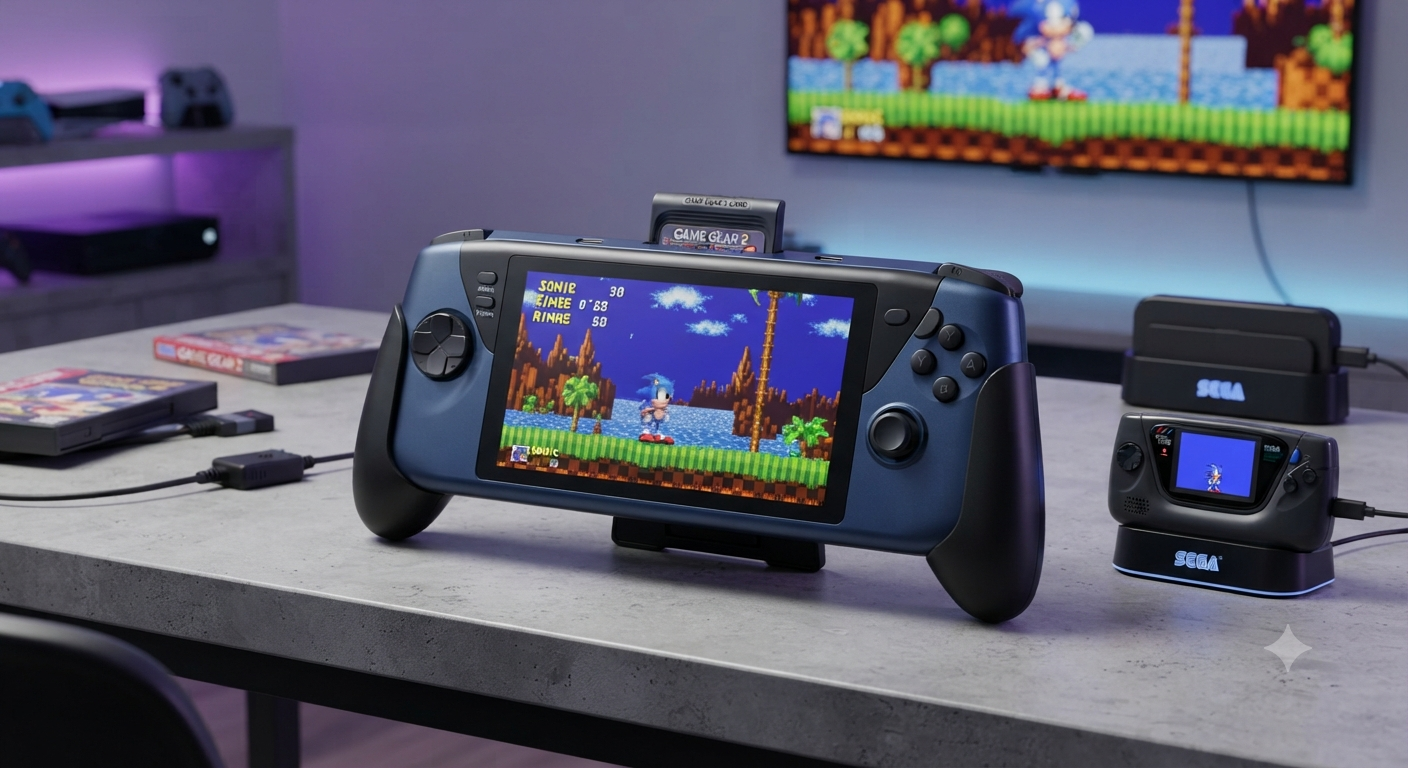
3. The Hardware Family: Dreamcast 2 vs. Game Gear 2 (Same Engine, Two Legends)
Instead of competing in a raw teraflops race or fragmenting developers with disparate architectures, Sega’s ecosystem unifies its power under the same custom Intel silicon and the exact same Mega-Cartridges, splitting into two ideal formats for every type of player:
| Feature | Dreamcast 2 ($349) | Game Gear 2 ($499) |
| Form Factor | Compact home micro-console | Hybrid OLED handheld with TV Dock |
| Processor | Custom Intel Arc Architecture | Identical efficient Intel chip (Same power) |
| Game Slot | Motorized front Mega-Cartridge slot | Top spring-loaded Mega-Cartridge slot |
| Digital Storage | Direct slot for microSD Express (Hard Drive) | Direct slot for microSD Express (Hard Drive) |
| Save / Peripherals | Wireless controller with VMU 2.0 slot | Dedicated chassis-flush microSD Express slot |
- Dreamcast 2 (The Home Console): Designed for the home purist. By eliminating the portable screen and battery, it offers an ultra-small footprint at an aggressive $350 price point. Direct power allows the chip to achieve native rendering up to 4K/60fps using Intel’s XeSS upscaling, complemented by a direct microSD Express slot that serves as the console’s internal storage.
- Game Gear 2 (The Hybrid Handheld): For the gamer seeking total mobility without sacrificing an ounce of performance. It features a 7-inch 1080p OLED panel with variable refresh rate (VRR) for fast-action games like Sonic and Crazy Taxi. By placing it into its magnetic dock, it connects to the living room TV, delivering the exact same experience and graphical performance as its home console sibling, while also utilizing its integrated microSD Express slot for digital games.
4. The Save System: VMU 2.0 and Controller Profiles
In an ecosystem built around video game preservation, cloud-only saves create a critical bottleneck. The new consoles solve this by reimagining the iconic Visual Memory Unit (VMU):
- The VMU 2.0 Smart Shell: When docked to the Dreamcast 2 wireless controller, the 2.4-inch AMOLED screen acts as a secondary HUD screen to display lightweight real-time telemetry (mini-maps, inventory, or play calling). This avoids wireless latency issues since heavy game assets run directly from the Mega-Cartridge or internal console storage. It also functions as a classic portable profile and mini-game module.
5. Online Ecosystem: Sega Online
To bridge the gap between physical media and modern connectivity, the platform introduces a robust native service that unifies the community at a highly competitive price: $4.99 USD/month or $39.99 USD/year:
- The “Sega Vault” (Retro Subscription): A subscription service backed by Sega’s immense historical catalog. Rotational access to an intergenerational vault of classic games spanning the Master System, Genesis/Mega Drive, Game Gear, Saturn, and the original Dreamcast.
- Frictionless Multiplayer: Optimized network connectivity for modern titles and competitive multiplayer, paying tribute to the pioneering spirit of old Sega Net paired with the speed and stability of modern gaming.
- The Physical-Digital Bridge: The subscription complements the Mega-Cartridges, offering exclusive benefits like annual commemorative physical editions for loyal subscribers.
6. Software Strategy and Exclusives
To make the hardware financially sustainable without sacrificing massive software revenues on rival platforms, Sega adopts a three-tier model:
- Tier 1: Console Sellers (Arcade Renaissance)
- Titles: Crazy Taxi: World Tour, Jet Set Radio, Golden Axe, Virtua Fighter 6.
- Purpose: Stylized exclusive titles stamped with arcade DNA for the Dreamcast 2 and Game Gear 2, designed to attract retro enthusiasts and loyal gamers.
- Tier 2: Timed Windows (6-to-12 Month Exclusivity)
- Titles: Mainline Sonic the Hedgehog entries.
- Purpose: Provides initial prestige for platform adopters before expanding to PC and other platforms.
- Tier 3: Day-One Multiplatform
- Titles: Atlus RPGs (Persona) and RGG Studio (Like a Dragon / Stranger Than Heaven).
- Purpose: Safeguards massive global multiplatform revenue across PC and rival consoles.
The Verdict
Reviving Sega’s legacy is not about competing in a sterile brute-force hardware war. By combining high-speed physical NAND Flash cartridges (Mega-Cartridges) for collecting, direct microSD Express console slots for cleanly managing internal digital storage, a cutting-edge processing alliance with Intel, and the versatility of the Dreamcast 2 and Game Gear 2, Sega could build a sustainable ecosystem that honors its history and genuinely preserves video games for the physical era.